Lucchio: The Village That Clings to the Rock
High above the Val di Lima, Lucchio literally clings to a cliff face. Houses without foundations, a fortress dating from the 14th century and deep silence — a Tuscan rock village you come upon rather than find.

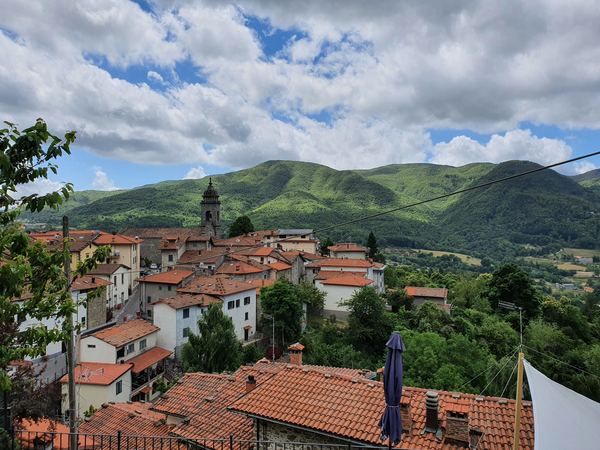
Lucchio in the Val di Lima is one of the most spectacular mountain villages in Tuscany: its houses cling directly to the limestone with no foundations, rising up to fifteen metres on the valley side, while at the back the roof tiles almost touch the grass. Above the village stands the Rocca di Lucchio, a fortress first documented in 1327. A visit rewards anyone who wants to combine architecture, history and hiking away from Tuscany's busiest routes. Drive up the narrow hairpin road, walk the last stretch on foot, and you find a living, if tiny, village with deep silence and a view across two provinces. ---
What makes Lucchio so special?
Some places in Tuscany are not so much found as encountered, and Lucchio is one of them. High up in the Val di Lima, on the border between the provinces of Lucca and Pistoia, the village hangs quite literally from a cliff. Not picturesquely arranged, but genuinely vertical: the foundations of the upper houses rest almost on the roofs of those below.
The way it is built is an architecture you rarely see. On the valley side the houses rise four to five storeys and drop away as an almost sheer wall. On the mountain side, by contrast, the roof tiles nearly brush the grass. This is not adaptation to nature but a fusion with it, grown straight out of the bare limestone.
Un'architettura mai vista! Le case sono incollate alla roccia.
An architecture never seen before, the houses are glued to the rock.
Mauro Corona & Matteo Righetto, Il passo del vento
Writers have been struck by the same impression. In their book Il passo del vento, Mauro Corona and Matteo Righetto describe Lucchio as a vertical village where the houses rise fifteen metres on the valley side while the tiles at the back kiss the grass. It is exactly this contrast that makes the first sight of Lucchio so unforgettable.

Why would a village cling to a vertical slope?
Lucchio was not built up there for romantic reasons, but for strategy. The Rocca di Lucchio, the fortress high above the village, was first documented in 1327. Current excavations suggest, however, that the site was settled centuries earlier; more on that below. From up here you could control the Val di Lima, and with it the road that linked the city of Pistoia to the Lima valley over the Passo dell'Oppio.
The Republic of Lucca used the Rocca as a military outpost against neighbouring Pistoia. Castruccio Castracani, the famous condottiero and lord of Lucca, turned the fortress into a stronghold in his wars for control of the Apennines. Its position mattered so much that after Castruccio's death the Rocca was disputed between Pistoia, Florence and Lucca until a peace treaty in 1433 returned it to Lucca for good.
The village itself benefited from the height: the sheer terrain made it practically impregnable and self-sufficient under siege. Below the village ran an old pilgrim path towards Croce a Veglia, where travellers found shelter and rest at the Spedaletto, of which only ruins remain today. The extreme setting, in other words, was no accident but a calculation.

What do the excavations at the Rocca reveal?
Since spring 2024, extensive restoration and archaeological excavation work has been under way at the Rocca di Lucchio, funded by the Italian Ministry of Culture and coordinated by the Soprintendenza for the provinces of Lucca and Massa Carrara. What the archaeologists have uncovered has surprised even the experts.
Inside the fortress they found the remains of a small church, more precisely an apse dating from the late 10th or early 11th century, around 200 years older than the first written record of the Rocca itself. The fortress was therefore not the beginning of the story of this place, but had overlaid an even older layer of settlement. A further find was a massive rectangular stone structure, partly hewn directly into the bedrock, that had been entirely unknown until now. (Source: Soprintendenza ABAP Lucca e Massa Carrara)
The public response has been considerable: at the first guided visit to the active dig site, so many people turned up that the archaeologists had to split them into three groups instead of the planned two. Anyone who wants to follow the ongoing work will find official updates and event announcements on the Soprintendenza website.
SoprintendenzaRocca di Lucchio — Excavations & updatessoprintendenzaluccaemassacarrara.cultura.gov.itLucchio today: few residents, deep silence
The image of a deserted ghost town is romantic but wrong. Lucchio is not dead, only small and seasonal. Around 30 people live here in winter, with a few more arriving in summer. They are people who choose to be here: new owners who have restored old stone houses, craftspeople drawn by the quiet, plus a small bar at the entrance to the village and a cheesemaker.
The village parish church is San Pietro, already listed in the records of the Diocese of Lucca in 1260 and rebuilt in the 17th century. Its bell tower dates from 1894, and inside stand a 16th-century baptismal font and a high altar of pietra serena. A little higher up, in the hamlet of Le Aie, Santa Maria delle Aie is the oldest church in the village and was probably the first parish.
The frazione of Lucchio takes in several small hamlets such as Castello, Grotta, Le Aie, Lucchio Bassa, Rocca and Zato. For a long time the local economy lived on the chestnut, which is still at the heart of village festivals and sagre. The steepness here is not nostalgia but daily reality, and that is exactly what makes the place authentic: no styled village set, just stone, silence and a view of the mountains.

How do you get to Lucchio, and what is there to do?
Lucchio is deliberately hard to reach. The village sits on a single narrow, winding road that branches off the SS12 state road, the Brennero road, in the Val di Lima at the limestone quarries of Tana Termini. From there it climbs the steep slope in tight hairpin bends. At some point the car can go no further: you park below and continue on foot, because the lanes are too narrow and too steep for vehicles.
Once up there, you move only on foot. You look down into the Val di Lima, find your way by the stone houses and by the Rocca, whose ruined walls sit freely accessible on the rocky ridge above the village. The climb up to them needs a sure step but rewards you with a wide view over the valley.
For walkers, this is where the ascent of the Penna di Lucchio begins, a striking rocky peak at 1,176 metres with a panorama across the Apuan Alps and the Apennine ridge. The route follows a ridge and runs partly over rock steps, nothing technical, but calling for grip and a sure step. Climbers will also find several bolted routes on the Penna. For a longer loop, the Penna di Lucchio pairs with the neighbouring Monte Memoriante, a classic ridge walk often started from the hamlet of Casoli.

Lucchio as a day trip from Gavinana
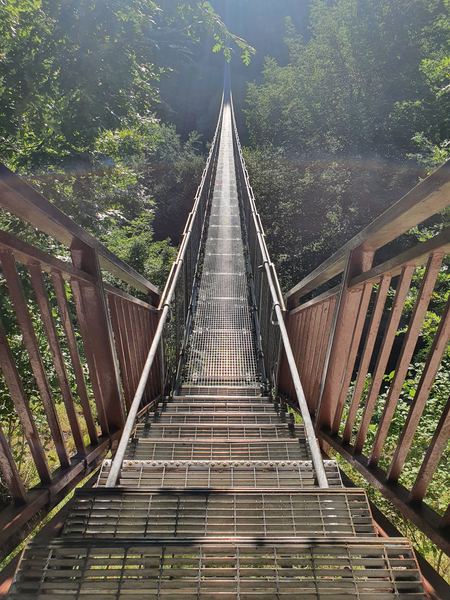
Lucchio lies about 17 kilometres from Gavinana, roughly 30 minutes by car through the Val di Lima. That makes the rock village a rewarding half-day trip for anyone holidaying in the Pistoia Apennines. If you like, pair the visit with a stop at the Ponte Sospeso delle Ferriere or with the spa town of Bagni di Lucca down in the valley.
| Starting point | Distance | By car |
|---|---|---|
| Gavinana | approx. 17 km | approx. 30 min. |
| Bagni di Lucca | approx. 16 km | approx. 20 min. |
| Lucca | approx. 45 km (28 mi) | approx. 1 h |
| Pistoia | approx. 45 km (28 mi) | approx. 1 h |
| Florence | approx. 90 km (56 mi) | approx. 1 h 30 min. |
In fact, you can see Lucchio from Borgo Bello itself: from the windows of the apartments the rock village appears on the opposite slope, and after dark the illuminated Rocca di Lucchio glows high above it. From our two holiday apartments in Gavinana the full range of this mountain world opens up, from the vertical architecture of Lucchio to the trails along the Apennine ridge. More about how and why Borgo Bello came to be is on our about page.

Frequently Asked Questions
Lucchio is reached by a single narrow, winding mountain road that branches off the SS12 state road (the Brennero road) in the Val di Lima at the limestone quarries of Tana Termini and climbs the slope in tight hairpin bends. You park below the village and walk the last stretch on foot, as the lanes are too narrow and too steep for vehicles.
No. Lucchio is small and seasonal but inhabited: around 30 people live here in winter, with a few more in summer. Many of the stone houses have been restored, and there is a small bar and a cheesemaker. The image of a deserted ghost town is romantic but wrong.
Yes. The remains of the medieval fortress can be reached on foot along a path. Sturdy footwear and a sure step are needed. Since spring 2024, active excavation and restoration work has been under way; access may therefore be restricted. Current information and guided visit dates are posted in the Lucchio community Facebook group.
Yes. The Penna di Lucchio is a striking rocky peak at 1,176 metres, reached by a ridge path from the village. The ascent runs partly over rock steps and requires a sure step. Climbers will also find several bolted routes on the Penna.
A Rock-Village Day with a Base — Borgo Bello in Gavinana
il Nido and il Loft in Gavinana lie just about 30 minutes' drive from Lucchio, deep in the Pistoia Apennines, with a view of the rock village and the night-lit Rocca on the opposite slope.